Guide
How to find your stopcock (before you need it in a hurry)
Where stopcocks hide in Manchester homes: under the sink, cellar heads, bathroom floors and outside meter boxes. How to free a seized one and when to fit a new valve.
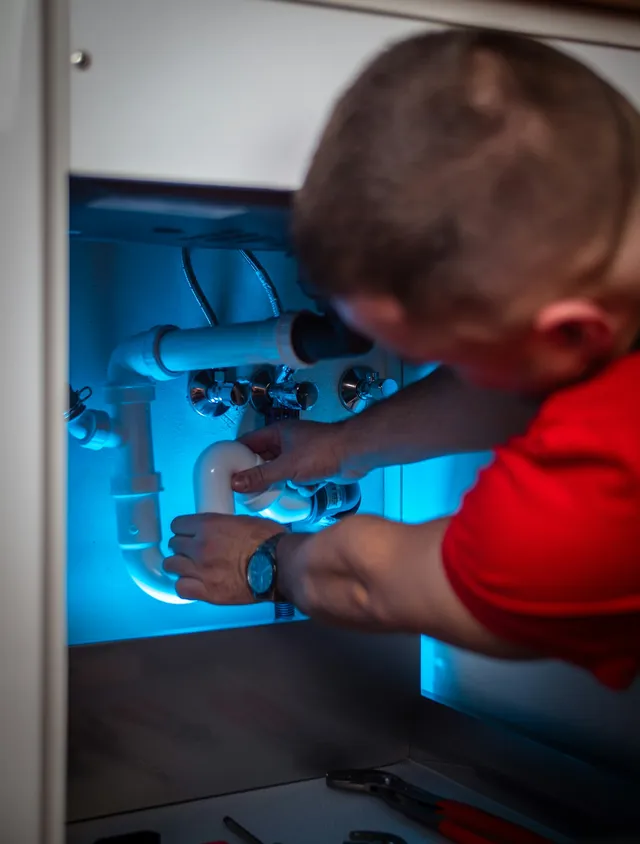
Here is a question we ask on nearly every emergency call: "Have you turned the water off at the stopcock?" And here is the answer we get far too often: "I don't know where it is." Nobody goes looking for their stopcock until water is coming through the ceiling, and by then every minute of searching is costing real money in damage.
So this guide has one job: get you to find your stopcock today, while everything is dry and calm. It takes ten minutes. It is the single most useful bit of plumbing knowledge in the house.
What the stopcock actually does
The stopcock (also called a stop tap or stop valve) is the valve that shuts off the cold mains where it enters your home. Close it and no more water comes into the house. Whatever is leaking, a burst pipe, a failed flexi hose under the basin, a split washing machine hose, closing the stopcock takes the pressure off it and turns a crisis into a puddle.
Most homes have two: an internal stopcock inside the house, and an external stop valve out at the boundary. You want to know where both are.
Where stopcocks hide
Under the kitchen sink. The classic spot and the first place to look. The mains usually enters the house at the kitchen, and the stopcock sits on the rising main, the vertical 15mm copper pipe at the back of the cupboard. Clear out the cleaning products and have a look.
The cellar head. Manchester special, this one. In the thousands of Victorian and Edwardian terraces across the city, in Levenshulme, Gorton, Salford, Old Trafford and the rest, the mains often comes in through the cellar, and the stopcock sits at the cellar head or on the cellar wall near the front of the house. If your house has a cellar, even a shallow one you never use, look there.
Under the stairs. Common in interwar semis and thirties builds. Often behind whatever has been stored in that cupboard for a decade.
Under a floorboard in the hall or bathroom. In some older houses the rising main runs under the ground floor and the stopcock sits in a small hatch or under a loose board near the front door, or under the bathroom floor where the pipework rises. If there is a suspiciously short or cut board near your front door, that may be why.
Downstairs toilet or utility room. Newer builds and extensions frequently put the stopcock behind the WC or beside the washing machine valves.
In a neighbour's property. Rare but real in converted flats and older terraces with shared supplies. If you genuinely cannot find one inside your own four walls, this is worth investigating before an emergency, not during one.
The reliable method if none of the usual spots pays off: find where the cold mains enters, the kitchen cold tap is almost always fed directly from it, and trace that pipe backwards. The first valve you meet on it is your stopcock.
The outside stop valve
Out at your property boundary, in the footpath or the edge of the drive, there is a small cover, plastic or cast iron, often marked "W" or "Water", with the water company's stop valve and usually the meter underneath. This shuts off the supply before it even reaches the house, which makes it your backup when the internal stopcock is seized, buried or broken.
Two things to sort in advance. First, find the cover and lift it once, they silt up and stick, and some are deep enough that you cannot reach the valve by hand. Second, buy a stopcock key, the long T-handled tool that turns the valve from the surface. They cost a few pounds at any DIY shed and live happily in the shed until the day they earn their keep. In older terraced streets one outside valve sometimes serves more than one house, so if you shut it in anger, expect a knock from next door.
Exercise it once a year
A stopcock that has not moved in twenty years is not a stopcock, it is a decoration. The mechanism scales and seizes in the open position, and the first anyone learns of it is mid-flood, heaving on a valve that will not budge.
So put it on the calendar, once a year: turn the stopcock fully off, run the kitchen cold tap to confirm the water actually stops (this also proves you have the right valve), then open it fully and bring it back a quarter turn. That quarter turn off the stop is an old plumber's habit that keeps the valve from jamming against its own end stop.
While you are down there, look at it. Green or white crust around the spindle, dampness on the pipe below, or a drip when you operate it are all signs the packing gland is weeping. A gentle nip of the gland nut cures some, but a valve that weeps and seizes is telling you its age.
Seized or broken stopcocks
If yours will not turn, resist the urge to put a wrench on it and lean. Old brass shears, spindles snap, and a snapped stopcock on a live main is exactly the emergency you were trying to prepare for. Penetrating oil on the spindle, patience, and gentle back-and-forth movement by hand is the safe limit of DIY here.
A stopcock that stays stuck should be replaced, calmly, at a time of your choosing. We shut off at the outside boundary valve, swap the old valve for a modern quarter-turn lever type, and you are back on within the hour. A lever valve is worth the tiny extra cost: in a panic, anyone in the house can flip a lever, including kids and visitors, with no strength and no guessing which way is off. This is the sort of small job our leak repair manchester engineers fit in alongside bigger work, and honestly, it is some of the best value plumbing money you can spend, because it changes what every future leak costs you.
Why this matters more than it sounds
The difference between a working, known stopcock and a missing one is measured in ceilings. Mains pressure pushes a lot of water through a split pipe, and in the time it takes to search cupboards, find a torch, and phone a relative who might remember, water is finding the light fittings. When a pipe lets go in a Manchester cold snap, the households that know their stopcock lose a bit of carpet, the ones that do not lose plaster, floors, and weeks to drying out. Our burst pipe repair manchester team can be with you fast, but nobody gets there faster than the person already standing next to the valve.
So, today: find it, turn it, label it. Ten minutes. And if it will not turn, or you have searched everywhere and genuinely cannot find one, ring us on 0161 533 0201 and we will sort it before the weather does.
Frequently asked questions
Which way do I turn a stopcock to shut the water off?
Clockwise to close, the same as a tap. Turn it gently until it stops, do not force it beyond that. To reopen, turn anticlockwise fully, then back a quarter turn. Leaving it a quarter turn off its fully open stop keeps the mechanism free and makes it far less likely to jam open the next time you need it.
My stopcock will not turn. What should I do?
Do not force it with a wrench, the spindle or the pipe can shear and then you have created the flood you were trying to prevent. Try penetrating oil on the spindle, leave it half an hour, then gentle back-and-forth pressure by hand. If it still will not move, treat the house as having no working stopcock and get it replaced at a planned time. In an actual emergency, use the outside stop valve at the boundary instead.
Can I turn the water off at the outside stop valve myself?
Yes, for the valve serving your own property. It lives under a small plastic or metal cover in the footpath or at the boundary, often alongside the meter, and usually needs a stopcock key, a long T-handled tool from any DIY shed. On shared supplies, common in older Manchester terraces, one outside valve can serve several houses, so warn your neighbours before you shut it.
How much does stopcock replacement cost?
It is a small planned job, typically well under the cost of an emergency call-out, and usually done within an hour, including shutting off at the outside valve while the old one is swapped. Modern quarter-turn lever valves cost little more than the traditional type and are far easier to use in a panic. We confirm the price before we start, as with all our work.
Does turning the stopcock off stop every leak in the house?
It stops anything fed by the cold mains, which covers most leaks. But a house with tanks in the loft or a hot water cylinder still has stored water that will keep feeding a leak after the mains is off. In that case, also open the taps to drain the system down, and if the leak is from a heating pipe the heating system holds its own water too. If in doubt, shut the stopcock, open the taps, and ring us.
Services that can help
Need a plumber in Manchester today?
Call us for a fast, honest quote. We cover Greater Manchester 24 hours a day, and we answer the phone.